Showing posts with label RFMONDIAL. Show all posts

Tuesday, March 23, 2021

DRM India Trial proves to be the ideal digital radio standard also in the FM band

Digital Radio Mondiale – DRM India Trial proves to be the ideal digital radio standard also in the FM band

The international, not-for-profit DRM Consortium has just concluded the demonstration and trial of the DRM digital radio standard in the FM band (VHF band-II) in New Delhi and Jaipur on March 22nd.  It was highly successful and generated a lot of interest.

The overwhelming success of the trial, which had started on February 24th, was registered in all the aspects required by Prasar Bharati (All India Radio): extensive features allowing radio innovation for broadcasters and listeners, excellent coverage, flexibility, spectrum and power efficiency, and proven CTI spectrum compliance.

In Delhi, the trial demonstrated excellent results when transmitting a single DRM signal, multiple pure digital DRM signals side-by-side from the same transmitter ("Multi-DRM" configuration), and also using DRM's simulcast option by putting on air both an analogue FM and a digital DRM signal from a single transmitter.

The Multi-DRM option proves DRM's highly economic potential when it comes to frequency and equipment upgrades: A single FM-band transmitter with a bandwidth of 600 kHz can transmit 6 independent DRM signals (blocks) carrying up to 24 DRM services, e.g. 18 audio and 6 multimedia services. These can represent up to 6 independent broadcasters who remain in full control over their individual content and signal configuration.

In Jaipur, the DRM Consortium showed on a separate antenna on the same tower for the first time in a live on-air environment, how Multi-DRM configurations with 4 and even 5 DRM blocks (each capable of carrying up to 3 audio services and one multimedia service like Journaline), can perfectly and efficiently use the white-spaces in-between two existing analogue FM services, while not affecting the reception of those ongoing FM services at all.

DRM services can be broadcast from the same 'Common Technical Platform' (CTI) in use today, housing multiple FM transmitters with a shared site and antenna. However, DRM takes this concept a step further by also turning the FM-band transmitter itself into a shared resource. This approach, ideal for the quickest introduction of digital services in the FM band without affecting the existing analogue services, not only minimises the one-time equipment investment for broadcasters in addition to the significant power cost savings. It also opens the door, for example, for public broadcasters to provide many regional services across the country from every local transmitter site by installing a single FM-band transmitter.

The trial in India proved the excellent expertise, cooperation and support of the DRM Consortium, whose 100 members' aim is to promote the only digital radio standard to upgrade existing AM and FM band services while maintaining established industry business models and regulatory aspects. Key Indian and international companies giving their full support to the trial included: Fraunhofer IIS, Nautel, NXP, RFmondial, Technomedia, BECIL and the DRM Indian Platform, along with various receiver manufacturers and automotive Tier-1s.

During the demonstration, DRM clearly showcased that the DRM standard, used in the FM band is backward compatible and receiver ecosystem for both AM and FM band services, is ready for India's mass market, based in the in-country know-how build-up and chipset design and production over the past years, which in turn is enabled by DRM being an open standard with all specifications published. Even DRM receiver models made in China today are based on Indian technology and DRM chipsets.

The DRM receivers in operation during the trial all supported DRM in both AM and FM bands. They comprised car receivers (line-fit and customer installed receiver upgrades), DRM reception on mobile phones and tablets, portable and desktop radios, as well as professional monitoring receivers.

With regards to car receivers, the trial was supported by companies like Mobis (Hyundai demo car), Harman (Maruti-Suzuki demo car), Starwaves' "India CarBox Radio" (customer installed car radio upgrade solution) and the whole DRM Automotive India Group. The DRM Automotive India Group, a recently launched industry representation body to help with the DRM roll-out, has already requested Prasar Bharati, All India Radio (AIR) and the government to support DRM in-car radios for both AM and FM band services, as the upgrade of existing car receivers to support DRM in FM band is a mere firmware upgrade without requiring redesigns or hardware changes. Therefore, DRM is perfectly positioned to quickly roll-out FM-band support by building on the over 2.5 million cars already deployed in India with DRM fitted receivers today.

Also proven was DRM's capability to being received on off-the-shelf Android phones deployed in India today by the billions, thanks to the Fraunhofer DRM MultimediaPlayer Radio App. DRM made the point that existing phone owners can easily upgrade their devices without the need to immediately buying new models, simply by attaching an external off-the-shelf dongle. The same dongle can also be used with tablets, laptops and desktop PCs to receive radio services, in all broadcast bands, not only in analogue but in DRM digital. too. The user-friendly radio handling, low battery consumption and stellar reception sensitivity of such solutions was demonstrated.

For the future deployment in India, native support of DRM FM-band reception is easily possible on all phones supporting analogue FM reception today by way of a simple firmware upgrade, without requiring manufacturers to add hardware components or carry out costly re‑designs. In addition, the superior xHE-AAC audio codec in use by DRM is already a default feature of all major mobile phone platforms, saving manufacturers IP royalty payments.

In both Delhi and Jaipur, a variety of portable and mobile DRM receivers checked the excellent performance of DRM in all configurations and at impressive distances from the transmitter. The broad variety of receiver types included a range of models of the Gospell 216 and the GR-22x series, the Starwaves DRM Stereo Radio Receiver W293, as well as multiple RFmondial RF-SE professional monitoring receivers.

Today, DRM has been adopted in India for successfully digitizing the AM bands. Extending the same global, open, non-proprietary DRM standard to the FM-band will not only save manufacturers enormous cost (as there is NO additional IP royalties) and lead to more affordable receivers for India. It will also create new revenue opportunities for commercial broadcasters, thanks to the option for multiple audio programmes and the Journaline advanced and interactive text feature. DRM in the FM band will also bring significant distribution and energy cost savings for better coverage, given that a single DRM transmitter can broadcast the DRM signals of multiple broadcasters and thus become a part of the cost-shared CTI infrastructure. In addition, DRM proved it can be introduced in the otherwise unusable frequency gaps between existing analogue FM services, while not affecting those FM services or their coverage at all.

The DRM Consortium is thankful for their great cooperation to All India Radio experts and staff and to all those who have made this highly successful, high-tech and ultra-efficient trial possible. It urges the Indian government to extend the use of the single DRM standard as the common solution for all radio bands in India: for maximum manufacturing efficiency and receiver penetration, for best-in-class features and coverage efficiency, for full support of the Indian automotive industry, and for building on the DRM know-how, expertise and manufacturing industries built-up in India over the past years for a speedy digitisation of the FM band.

For more information on DRM and how to get involved in the work of the Platform please go to: www.drm.org.

5x Multi-DRM signal as shown in Jaipur in-between two high-power analogue FM services

Basic DRM transmission with 3 audio services +Jounaline and slideshow (with station logos and Unicode support)

                                     DRM provides drivers with traffic and travel information


Monday, September 16, 2019

DRM at IBC 2019 - Going from Strength to Strength


DRM Highlights 'Smart Radio for All' at IBC 2019

Under the overarching theme "DRM – Smart Radio for All" the DRM Consortium had two interactive sessions looking at the practical implementation of DRM in various parts of the world. The sessions also focused on new receivers and enhancements to DRM equipment.

The first event on Friday 13th September hosted by Gospell under the title "The Gospell Receiver – End to End Solution for Your Needs", highlighted great developments in digital DRM roll-out in China and new upgrades, multi-feature and multi-standard receivers (such as the GR22) and receiver solutions from the company.   Gospell announced three DRM products; an affordable DRM receiver, car adapter and a professional measurement receiver.

On Saturday the 14th,  during an interactive sess
ion, held at the Nautel booth a panel of digital radio experts from the Consortium, answered questions on the latest implementation of DRM across the world (India, China, South Africa, Russia).

Fraunhofer IIS provided more details on the latest major release of the new DRM ContentServer R7 head-end technology for Digital Radio DRM (and DAB+). The DRM ContentServer R7 enables broadcasters to ensure consistent loudness within one programme and between programmes and builds resilience with backup audio coding to get over any interruption.

During the Nautel event RFmondial also demonstrated its advanced multiplexed DRM modulation for the FM band, that allows broadcasters to transmit multiple DRM channels on one physical transmitter.

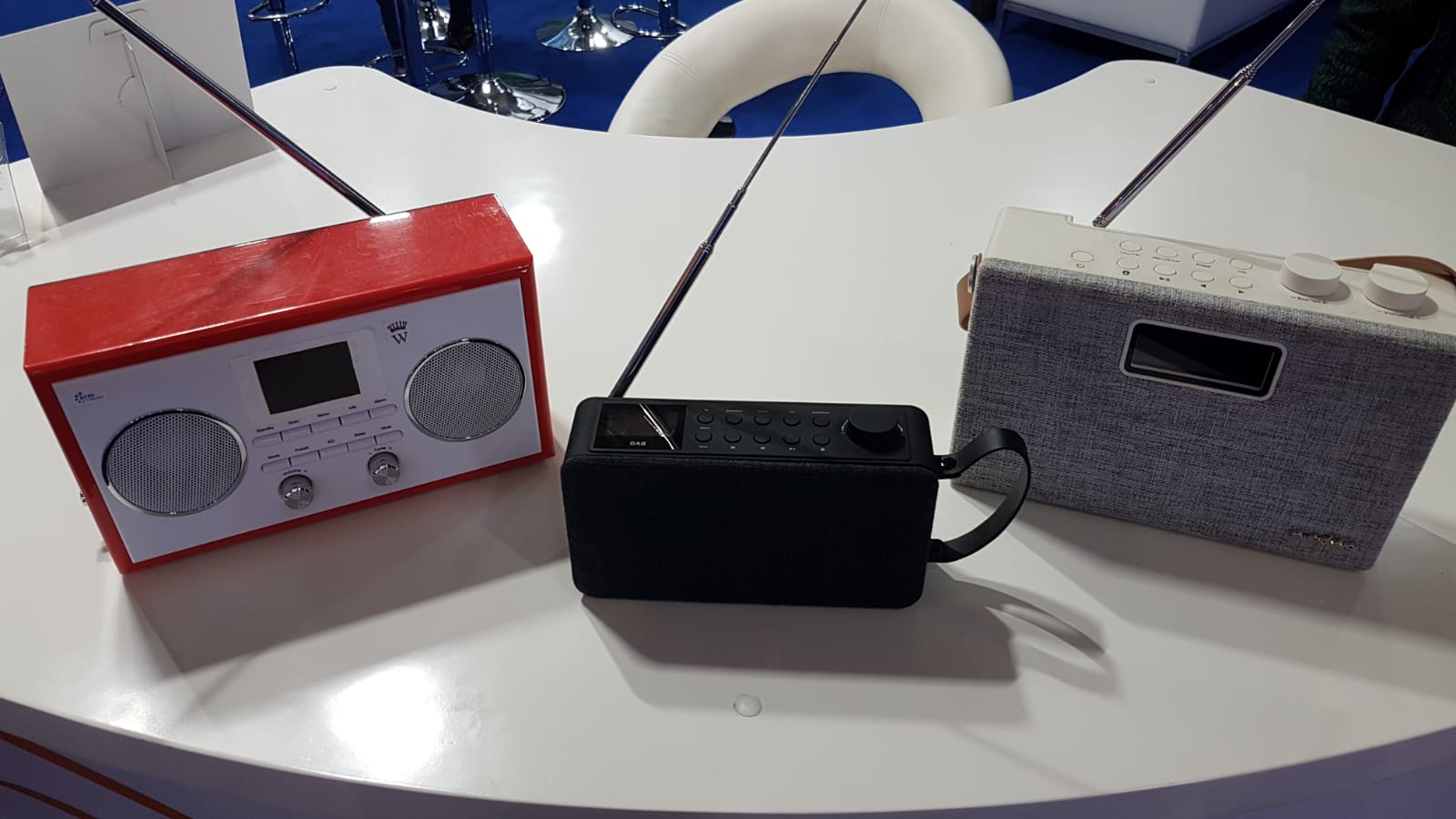
Participants were also able to see and ask questions about the new all-band receiver, the result of the cooperation between Nedis, the Dutch consumer goods company and STARWAVES (an innovative technology radio solution company).  

On the panel were: Ruxandra Obreja (Chair, DRM Consortium), Wendell Lonergan (Nautel), Alexander Zink(Fraunhofer IIS), Haochun Liu (Gospell), Thembeka Khaka (Thembeka Khaka & Associates) and Jan Hein Knip (Nedis).

Ruxandra Obreja, the Consortium Chairman, says that: "IBC 2019 was great for DRM.  New roll out programmes and demos in India, China, several other Asian countries, Russia, Africa and Europe.  New receiver solutions, a new car adapter and improved transmitters and content servers.  DRM is going from strength to strength."

Consortium members at the IBC exhibition included: BBC, Encompass Digital, JVCKenwood, NXP, RFmondial and Sony.


From R to L - Haochun Liu (Gospell), Ruxandra Obreja (DRM, Chair,) Wendell Lonergan (Nautel), Alexander Zink (Fraunhofer IIS), Thembeka Khaka (Thembeka Khaka & Associates), Jan Hein Knip (Nedis)

(Press Release)

Sunday, September 15, 2019

RFmondial demonstrates multiplexed DRM at IBC 2019

Hannover, 12.09.2019 – RFmondial demonstrates its advanced multiplexed DRM modulation for the FM band, that allows broadcasters to transmit multiple DRM channels on one physical transmitter.

The newest member of RFmondial's successful LV-series of DRM modulators and exciters allows the parallel generation and transmission of up to six pure digital DRM channels, or in combined analog and digital „Simulcast" mode, one traditional analog FM channel and up to four DRM channels.

"The ability to freely mix and combine analog and multiple digital DRM signals, in adjacent channels, with individually varying power levels, supporting single frequency networks, allows broadcasters, network regulators and frequency planers a new dimension of possibilities for planning and operation of digital radio networks" states Stefan Galler, Managing Director of RFmondial GmbH in Hannover.

RFmondial demonstrates its innovation with its long-time digital radio partner Nautel at IBC 2019 (RAI Congress Center in Amsterdam, September 13-17, 2019) hall8, booth C.49

RFmondial GmbH
Appelstr. 9a
30167 Hannover
Stefan Galler
+49 (511) 330995 61

RFmondial GmbH offers professional products and services for the digital broadcasting industry as well as other industries with the need for innovative hardware and software. Research, development and prototype implementation for transmitter, receiver, and monitoring technology as well as design services for various industries are part of the core business. With broad experience in various technological areas, world-wide markets are served, "Made in Germany".

(Press Release via openPR)


Sunday, March 22, 2015

Digital Radio Mondiale test by RFmondial & Leibniz University using Ampegon transmitter

DRM Digital Radio Mondiale: International Acceptance through Field Test Platform in Hannover
 
Ampegon supports one of the worldwide leading DRM test locations with a solid state low power transmission system to enable verified measurements, tests and reports
 
Turgi, Switzerland, March 20, 2015. Ampegon has granted a solid state low power (500 W) transmission solution to RFmondial GmbH in Hannover, Germany. In cooperation with the Institute of Communication Technology (IKT) at the Leibniz Universität Hannover the transmitter enables technologists to continue expert measurements and demonstrations of the DRM standard on regular city environmental broadcasting conditions. A broadcast license for 26.045 MHz shortwave has been given to the Leibniz Universität Hannover.
 
The installation will bring DRM technology and research equipment to the campus laboratory allowing technical demonstrations for professional listeners and reception results. The use of the equipment in mobile configuration enables a testing environment for improved car radio receivers with live reception inside a city. The unlimited access and the flexible operation of the broadcast chain including all possible configurations and power levels will help to test and demonstrate DRM live broadcast and will show the technical strength of the technology. The equipment is fully remote accessible for unmanned operation.
 
New algorithms, coding and power improvements will be tested and verified. System linearization and coverage conditions for several operation modes are under examination. The measurements and reports are well received in international technical publications and conferences.
 
This DRM installation is a complete DRM service chain maintained and operated by RFmondial together with the Leibniz Universität Hannover and the support of Fraunhofer IIS. It co-exists next to a DRM transmission in the FM band at 95.2 MHz. In parallel to experiments under their own supervision, the service is offered to receiver, module or chip-set manufacturers to verify and improve their implementations under real environmental conditions.
 
Tel. +41 58 710 44 00
 

(Press Release)


Friday, September 20, 2013

Comcon and RFmondial to deliver DRM professional monitoring receivers for India’s digital radio program

New Delhi (India), Hannover (Germany) (10/09/13)

Comcon, a leading solution provider to the broadcast and media industry in India, will deliver 36 DRM professional monitoring receivers manufactured by Germany's RFmondial, a leading manufacturer of DRM transmitter and receiver equipment. The delivery is one important component within the US$ 300 Million worth investment program of India's public radio All India Radio (AIR) to switch from analogue to digital radio broadcasting. Currently in production, the professional monitoring receiver model RFmondial RF-SE will be operational at 36 transmitter sites until the mid 2014.

RF-SE is a professional digital radio monitoring and measurement receiver, which is available in different models depending on the desired application. The outstanding reception characteristics are based on a high-performance frontend with preselector filter banks and a digital direct-down conversion system approach. After the well-proven digital base-band decoder various modular blocks like RSCI capability, audio and multimedia decoder, alarm feature, and RFmonitor connector are available to suite the specific needs of the desired application. Furthermore, the advanced graphical user interface is accessible via a web-browser and hence provides the operator access to all measurement data, but also to audio and multimedia streaming of
the current radio program on air.

More at :