Showing posts with label RFA QSL. Show all posts

Sunday, March 30, 2025

RFA Reception Reports and QSL cards

Message from Radio Free Asia.....

Dear friends,

Last weekend Radio Free Asia lost its grant and funding.
Unfortunately, we are unable to confirm any more reception reports.  
If this situation changes, we will let you know.  

As our relay sites stop transmitting our broadcasts, currently, we're still airing evergreen programming on limited frequencies but it's unclear how long this will continue.
Thank you for listening and also for your years of support and friendship.

RFA's QSL Team

Thursday, January 02, 2025

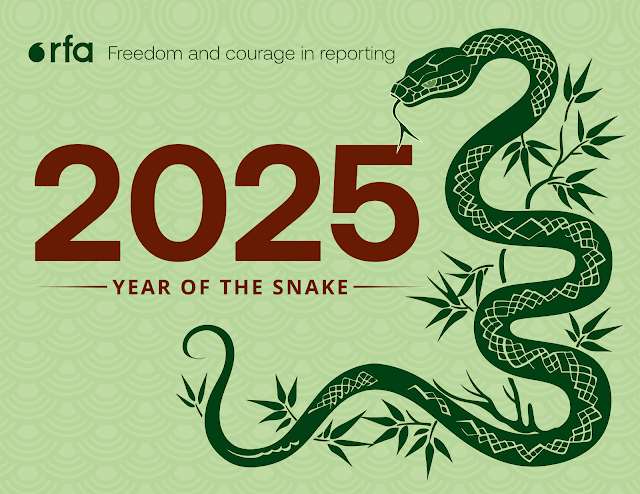
RADIO FREE ASIA ANNOUNCES QSL CARD #87

RADIO FREE ASIA ANNOUNCES QSL CARD #87

Radio Free Asia (RFA) is excited to announce its latest QSL card marking the beginning of the new year—the Year of the Snake. For more than 28 years, RFA has delivered accurate, uncensored, domestic news to people living under authoritarian regimes across Asia and globally to populations vulnerable to malign influence. Through its in-depth, unflinching journalism, RFA brings to light consequential developments in China, North Korea, Myanmar, Laos, Cambodia and Vietnam, as well as the Pacific region. This is RFA's 87th QSL design and will be used to confirm all valid RFA reception reports from January – April 2025.

RFA's QSL CARD #87

Created by Congress in 1994 and incorporated in 1996, RFA broadcasts in Burmese, Cantonese, Khmer, Korean to North Korea, Lao, Mandarin Chinese, Vietnamese, Tibetan (including Uke, Amdo, and Kham dialects), and Uyghur. RFA strives for accuracy, balance, and fairness in our editorial content. As a 'surrogate' broadcaster, RFA provides news and commentary specific to each of our target countries, acting as the free press these countries lack. RFA broadcasts only in local languages and dialects, and most of our broadcasts comprise news of specific local interest.  More information about RFA, including our current broadcast frequency schedule, is always available at www.rfa.org.

RFA encourages listeners to submit reception reports.  Reception reports are valuable to RFA as they help us evaluate the signal strength and quality of our transmissions.  RFA confirms all accurate reception reports by mailing a QSL card to the listener.  RFA welcomes all reception report submissions not only from DX'ers, but also from our general listening audience.

Reception reports are accepted by email at qsl@rfa.org and by mail to:

Reception Reports
Radio Free Asia
2025 M. Street NW, Suite 300
Washington DC 20036
United States of America

(RFA Press Release)

Sunday, September 01, 2024

Radio Free Asia announces QSL Card # 86

Radio Free Asia (RFA) announces its latest QSL card celebrating 28 years of delivering accurate, uncensored, domestic news to people living under authoritarian regimes across Asia and globally to populations vulnerable to malign influence. Through its in-depth, unflinching journalism, RFA brings to light consequential developments in China, North Korea, Myanmar, Laos, Cambodia and Vietnam, as well as the Pacific region. This is RFA's 86th QSL design and will be used to confirm all valid RFA reception reports from September – December 2024.

..................................................................RFA's QSL CARD #86

Created by Congress in 1994 and incorporated in 1996, RFA broadcasts in Burmese, Cantonese, Khmer, Korean to North Korea, Lao, Mandarin Chinese, Vietnamese, Tibetan (including Uke, Amdo, and Kham dialects), and Uyghur. RFA strives for accuracy, balance, and fairness in our editorial content. As a 'surrogate' broadcaster, RFA provides news and commentary specific to each of our target countries, acting as the free press these countries lack. RFA broadcasts only in local languages and dialects, and most of our broadcasts comprise news of specific local interest.  More information about RFA, including our current broadcast frequency schedule, is always available at www.rfa.org.

RFA encourages listeners to submit reception reports.  Reception reports are valuable to RFA as they help us evaluate the signal strength and quality of our transmissions.  RFA confirms all accurate reception reports by mailing a QSL card to the listener.  RFA welcomes all reception report submissions not only from DX'ers, but also from our general listening audience.

Reception reports are accepted by email at qsl @ rfa.org and by mail to :

Reception Reports
Radio Free Asia
2025 M. Street NW, Suite 300
Washington DC 20036
United States of America

Tuesday, January 02, 2024

Radio Free Asia announces QSL Card #84

Radio Free Asia announces QSL Card #84

To welcome the Year of the Dragon, Radio Free Asia (RFA) announces its latest QSL card. While we are celebrating together with all of you to welcome a happy, healthy and prosperous new year, RFA wanted to highlight a value we hold dear, Article 19 of The Universal Declaration of Human Rights: "Everyone has the right to freedom of opinion and expression; this right includes freedom to hold opinions without interference and to seek, receive, and impart information and ideas through any media and regardless of frontiers." This is RFA's 84th QSL design and will be used to confirm all valid RFA reception reports from January – April 2024.

Created by Congress in 1994 and incorporated in 1996, RFA broadcasts in Burmese, Cantonese, Khmer, Korean to North Korea, Lao, Mandarin Chinese, Vietnamese, Tibetan (including Uke, Amdo, and Kham dialects), and Uyghur. RFA strives for accuracy, balance, and fairness in our editorial content. As a 'surrogate' broadcaster, RFA provides news and commentary specific to each of our target countries, acting as the free press these countries lack. RFA broadcasts only in local languages and dialects, and most of our broadcasts comprise news of specific local interest.  More information about RFA, including our current broadcast frequency schedule, is always available at www.rfa.org

RFA encourages listeners to submit reception reports.  Reception reports are valuable to RFA as they help us evaluate the signal strength and quality of our transmissions.  RFA confirms all accurate reception reports by mailing a QSL card to the listener.  RFA welcomes all reception report submissions not only from DX'ers, but also from our general listening audience.

Reception reports are accepted by email at qsl@rfa.org and by mail to:

Reception Reports
Radio Free Asia
2025 M. Street NW, Suite 300
Washington DC 20036
United States of America

Monday, April 24, 2023

Radio Free Asia announces QSL Card #82

Radio Free Asia (RFA) is proud to announce new QSL card honoring the arrival of spring in the Northern Hemisphere. Nothing characterizes this more than the annual arrival of the cherry blossoms in Washington DC. "The tradition of celebrating the blooming of cherry trees in Japan is centuries old. The planting of cherry trees in Washington DC originated in 1912 as a gift of friendship to the People of the United States from the People of Japan. In Japan, the flowering cherry tree, or Sakura, is an important flowering plant. The beauty of the cherry blossom is a symbol with rich meaning in Japanese culture. For more than a hundred years, we have celebrating cherry trees blooming in solidarity." (source: nps.gov) This is RFA's 82nd QSL design and will be used to confirm all valid RFA reception reports from May – August 2023.

Created by Congress in 1994 and incorporated in 1996, RFA broadcasts in Burmese, Cantonese, Khmer, Korean to North Korea, Lao, Mandarin Chinese, Vietnamese, Tibetan (including Uke, Amdo, and Kham dialects), and Uyghur. RFA strives for accuracy, balance, and fairness in our editorial content. As a 'surrogate' broadcaster, RFA provides news and commentary specific to each of our target countries, acting as the free press these countries lack. RFA broadcasts only in local languages and dialects, and most of our broadcasts comprise news of specific local interest. More information about RFA, including our current broadcast frequency schedule, is always available at www.rfa.org.

RFA encourages listeners to submit reception reports. Reception reports are valuable to RFA as they help us evaluate the signal strength and quality of our transmissions. RFA confirms all accurate reception reports by mailing a QSL card to the listener. RFA welcomes all reception report submissions not only from DX'ers, but also from our general listening audience.

Reception reports are accepted by email at qsl@rfa.org and by mail to:

Reception Reports
Radio Free Asia
2025 M. Street NW, Suite 300
Washington DC 20036
United States of America

Wednesday, December 28, 2022

Radio Free Asia announces QSL Card #81

To welcome the Year of the Rabbit, Radio Free Asia (RFA) announces its latest QSL card. RFA is closing out an historic year of impactful reporting and exciting growth, during which we have begun broadening our programming and storytelling capacity, as well as updating our technological infrastructure. As we continue our expansion, we look forward to serving our audiences in 2023! This is RFA's 81st. QSL design and will be used to confirm all valid RFA reception reports from January – April 2023.

                                                              RFA's QSL CARD #81

Created by Congress in 1994 and incorporated in 1996, RFA broadcasts in Burmese, Cantonese, Khmer, Korean to North Korea, Lao, Mandarin Chinese, Vietnamese, Tibetan (including Uke, Amdo, and Kham dialects), and Uyghur. RFA strives for accuracy, balance, and fairness in our editorial content. As a 'surrogate' broadcaster, RFA provides news and commentary specific to each of our target countries, acting as the free press these countries lack. RFA broadcasts only in local languages and dialects, and most of our broadcasts comprise news of specific local interest.  More information about RFA, including our current broadcast frequency schedule, is always available at www.rfa.org.

RFA encourages listeners to submit reception reports.  Reception reports are valuable to RFA as they help us evaluate the signal strength and quality of our transmissions.  RFA confirms all accurate reception reports by mailing a QSL card to the listener.  RFA welcomes all reception report submissions not only from DX'ers, but also from our general listening audience.

Reception reports are accepted by email at qsl@rfa.org and by mail to:
Reception Reports
Radio Free Asia
2025 M. Street NW, Suite 300
Washington DC 20036
United States of America

Tuesday, August 30, 2022

Radio Free Asia announces 26th Anniversary QSL

Radio Free Asia (RFA) announces its latest QSL card commemorating 26 years of impactful work in some of the world's most restricted media environments, such as China, North Korea, Vietnam, and Burma. Since its founding, RFA has filled a crucial gap for the tens of millions of people living in these and other places in Asia and the world, who would otherwise have little or no access to accurate, timely domestic news and information in their languages. This is RFA's 80th QSL design and will be used to confirm all valid RFA reception reports from September – December 2022.


                                                           RFA's 26th ANNIVERSARY QSL

Created by Congress in 1994 and incorporated in 1996, RFA broadcasts in Burmese, Cantonese, Khmer, Korean to North Korea, Lao, Mandarin Chinese, Vietnamese, Tibetan (including Uke, Amdo, and Kham dialects), and Uyghur. RFA strives for accuracy, balance, and fairness in our editorial content. As a 'surrogate' broadcaster, RFA provides news and commentary specific to each of our target countries, acting as the free press these countries lack. RFA broadcasts only in local languages and dialects, and most of our broadcasts comprise news of specific local interest.  More information about RFA, including our current broadcast frequency schedule, is always available at www.rfa.org.

RFA encourages listeners to submit reception reports.  Reception reports are valuable to RFA as they help us evaluate the signal strength and quality of our transmissions.  RFA confirms all accurate reception reports by mailing a QSL card to the listener.  RFA welcomes all reception report submissions not only from DX'ers, but also from our general listening audience.

Reception reports are accepted by email at qsl@rfa.org and by mail to:

Reception Reports
Radio Free Asia
2025 M. Street NW, Suite 300
Washington DC 20036
United States of America

Monday, May 02, 2022

Radio Free Asia announces Radio Pioneer QSL # 6

Radio Free Asia (RFA) announces the 6th design in our 'radio pioneer' QSL card series. Reginald Aubrey Fessenden, 1866-1932, was a Canadian-born inventor who did a majority of his work in the United States. During his life he received hundreds of patents in various fields, most notably ones related to radio and sonar. Fessenden is best known for his pioneering work developing radio technology, including the foundations of amplitude modulation (AM) radio. His achievements included the first transmission of speech by radio (1900), and the first two-way radiotelegraphic communication across the Atlantic Ocean (1906). This is RFA's 79th QSL design and is used to confirm all valid RFA reception reports from May – August 2022.


                                  RFA's Radio Pioneer QSL #6 – Reginald Aubrey Fessenden

Created by Congress in 1994 and incorporated in 1996, RFA broadcasts in Burmese, Cantonese, Khmer, Korean to North Korea, Lao, Mandarin Chinese, Vietnamese, Tibetan (including Uke, Amdo, and Kham dialects), and Uyghur. RFA strives for accuracy, balance, and fairness in our editorial content. As a 'surrogate' broadcaster, RFA provides news and commentary specific to each of our target countries, acting as the free press these countries lack. RFA broadcasts only in local languages and dialects, and most of our broadcasts comprise news of specific local interest.  More information about RFA, including our current broadcast frequency schedule, is always available at www.rfa.org

RFA encourages listeners to submit reception reports.  Reception reports are valuable to RFA as they help us evaluate the signal strength and quality of our transmissions.  RFA confirms all accurate reception reports by mailing a QSL card to the listener.  RFA welcomes all reception report submissions at http://techweb.rfa.org (follow the QSL REPORTS link) not only from DX'ers, but also from our general listening audience.

Reception reports are also accepted by email at qsl@rfa.org and by mail to :

Reception Reports
Radio Free Asia
2025 M. Street NW, Suite 300
Washington DC 20036
United States of America
 

Monday, December 21, 2020

Radio Free Asia announces year of the Ox QSL

Radio Free Asia (RFA) has announced its latest QSL card commemorating 2021 as the Year of the Ox according to the Chinese astrology calendar. 

People born in ox years are considered kind, caring, logical, positive, having a great deal of common sense, and live with their feet 'firmly planted on the ground.' They are also considered to be hard workers in order to provide comfort and security for their families, while also highly intelligent and strong minded. The ox is one of 12 animals used in the Chinese Zodiac; the others are tiger, rabbit, dragon, snake, horse, goat, monkey, rooster, dog, pig and rat. 

This QSL card confirms all valid reception reports from January 1 – April 30, 2021. The design was created by RFA's Brian Powell.

Created by Congress in 1994 and incorporated in 1996, RFA broadcasts in Burmese, Cantonese, Khmer, Korean to North Korea, Lao, Mandarin Chinese, Vietnamese, Tibetan (including Uke, Amdo, and Kham dialects), and Uyghur. RFA strives for accuracy, balance, and fairness in our editorial content. As a 'surrogate' broadcaster, RFA provides news and commentary specific to each of our target countries, acting as the free press these countries lack. RFA broadcasts only in local languages and dialects, and most of our broadcasts comprise news of specific local interest. 

More information about RFA, including our current broadcast frequency schedule, is always available at www.rfa.org.

RFA encourages listeners to submit reception reports. Reception reports are valuable to RFA as they help us evaluate the signal strength and quality of our transmissions. RFA confirms all accurate reception reports by mailing a QSL card to the listener. RFA welcomes all reception report submissions at http://techweb.rfa.org (follow the QSL REPORTS link) not only from DX'ers, but also from our general listening audience.

Reception reports are also accepted by email at qsl@rfa.org and by mail to:
Reception Reports
Radio Free Asia
2025 M. Street NW, Suite 300
Washington DC 20036
United States of America

(A.J.Janitschek, RFA)

Thursday, December 12, 2019

Radio Free Asia releases Year of the Rat QSL

Radio Free Asia (RFA)announces its Chinese Lunar Year QSL

The Year of the Rat begins January 25, 2020 and ends February 11, 2021. The rat is one of twelve animals used in the Chinese zodiac. Those born in a rat year are considered ambitious, meticulous, industrious and sociable. They are also are very focused, naturals at following their instincts, and they are highly attentive which supposedly makes them excellent in business. This is RFA's 72ndQSL and is used to confirm all valid RFA reception reports January – April 2020.

Created by Congress in 1994 and incorporated in 1996, RFA broadcasts in Burmese, Cantonese, Khmer, Korean to North Korea, Lao, Mandarin Chinese, Vietnamese, Tibetan (including Uke, Amdo, and Kham dialects), and Uyghur. RFA strives for accuracy, balance, and fairness in our editorial content. As a 'surrogate' broadcaster, RFA provides news and commentary specific to each of our target countries, acting as the free press these countries lack. RFA broadcasts only in local languages and dialects, and most of our broadcasts comprise news of specific local interest.  More information about RFA, including our current broadcast frequency schedule, is always available at www.rfa.org.

RFA encourages listeners to submit reception reports.  Reception reports are valuable to RFA as they help us evaluate the signal strength and quality of our transmissions. RFA confirms all accurate reception reports by mailing a QSL card to the listener.  RFA welcomes all reception report submissions at http://techweb.rfa.org (follow the QSL REPORTS link) not only from DXers, but also from our general listening audience.

Reception reports are also accepted by email at qsl@rfa.org and by mail to:

Reception Reports
Radio Free Asia
2025 M. Street NW, Suite 300
Washington DC 20036
United States of America

Wednesday, January 02, 2019

Radio Free Asia commemorates 'Year of the pig" with a new QSL card

Radio Free Asia (RFA) announces its 2019 Year of the Pig QSL.

Those born in a Pig years are considered energetic, positive thinkers and gentle. They are also focused and when they make up their minds to do something, there is evidently little you can do to stop them. Pigs lead very busy lives and must remember to take breaks in order to rest. Pig years are celebrated every twelfth year.

The other Chinese zodiac animals and associated years are Rat, Ox, Tiger, Rabbit, Dragon, Snake, Horse, Goat, Monkey, Rooster and Dog. This is RFA's 69th QSL design and is used to confirm all valid RFA reception reports from January – April 2019.


RFA's 2019 Year of the Pig QSL

Created by Congress in 1994 and incorporated in 1996, RFA broadcasts in Burmese, Cantonese, Khmer, Korean to North Korea, Lao, Mandarin (including the Wu dialect), Vietnamese, Tibetan (Uke, Amdo, and Kham), and Uyghur. RFA strives for accuracy, balance, and fairness in its editorial content. As a 'surrogate' broadcaster, RFA provides news and commentary specific to each of its target countries, acting as the free press these countries lack. RFA broadcasts only in local languages and dialects, and most of its broadcasts comprise news of specific local interest. More information about Radio Free Asia, including our current broadcast frequency schedule, is available at www.rfa.org. RFA encourages listeners to submit reception reports. Reception reports are valuable to RFA as they help us evaluate the signal strength and quality of our transmissions. RFA confirms all accurate reception reports by mailing a QSL card to the listener.

RFA welcomes all reception report submissions at http://techweb.rfa.org (follow the QSL REPORTS link) not only from DX'ers, but also from its general listening audience.

Reception reports are also accepted by email at qsl@rfa.org and by mail to:
Reception Reports
Radio Free Asia
2025 M. Street NW, Suite 300
Washington DC 20036
United States of America

Monday, April 23, 2018

RFA releases new QSL in IBB relay site series - IBB Lampertheim

Radio Free Asia (RFA) announces the release of the fifth QSL card in the series highlighting the International Broadcasting Bureau (IBB) relay sites used for RFA programming. RFA programs also broadcasts from these IBB sites: Biblis, Kuwait, Saipan and Tinian. IBB Lampertheim is one function of the IBB's Germany Station and is also an integral part of IBB's global satellite interconnect system (SIS) carrying RFA programming where needed. This is RFA's 67th QSL overall and will be used to confirm all valid RFA reception reports from May – August 2018.
RFA's 5th IBB Relay Site QSL – IBB Lampertheim
                                        
Created by Congress in 1994 and incorporated in 1996, RFA broadcasts in Burmese, Cantonese, Khmer, Korean to North Korea, Lao, Mandarin (including the Wu dialect), Vietnamese, Tibetan (Uke, Amdo, and Kham), and Uyghur. RFA strives for accuracy, balance, and fairness in its editorial content. As a 'surrogate' broadcaster, RFA provides news and commentary specific to each of its target countries, acting as the free press these countries lack. RFA broadcasts only in local languages and dialects, and most of its broadcasts comprise news of specific local interest. More information about Radio Free Asia, including our current broadcast frequency schedule, is available at www.rfa.org.

RFA encourages listeners to submit reception reports. Reception reports are valuable to RFA as they help us evaluate the signal strength and quality of our transmissions. RFA confirms all accurate reception reports by mailing a QSL card to the listener. RFA welcomes all reception report submissions at http://techweb.rfa.org (follow the QSL REPORTS link) not only from DX'ers, but also from its general listening audience.

Reception reports are also accepted by email at qsl@rfa.org and by mail to:
Reception Reports
Radio Free Asia
2025 M. Street NW, Suite 300
Washington DC 20036
United States of America.
# # #

Wednesday, January 24, 2018

New RFA QSL commemorates the 2018 winter Olympiad

Radio Free Asia (RFA) announces its 66th QSL card

This latest design commemorates the 2018 Winter Olympic Games in PyeongChang, Republic of Korea scheduled for February 9-25, 2018. The Games always bring people together from around the world in peace and harmony to respect universal moral principles. This new design shows an adaptation of RFA's first panda design originally used for the 2008 Beijing Olympics. This updated version of the original design adds a winter cap stylized to match the Games. This QSL design is used to confirm all valid reception reports from January – April 2018.


RFA's QSL commemorating the 2018 Winter Olympics

Created by Congress in 1994 and incorporated in 1996, RFA broadcasts in Burmese, Cantonese, Khmer, Korean to North Korea, Lao, Mandarin (including the Wu dialect), Vietnamese, Tibetan (Uke, Amdo, and Kham), and Uyghur. RFA strives for accuracy, balance, and fairness in its editorial content. As a 'surrogate' broadcaster, RFA provides news and commentary specific to each of its target countries, acting as the free press these countries lack. RFA broadcasts only in local languages and dialects, and most of its broadcasts comprise news of specific local interest. More information about Radio Free Asia, including our current broadcast frequency schedule, is available at www.rfa.org.

RFA encourages listeners to submit reception reports. Reception reports are valuable to RFA as they help us evaluate the signal strength and quality of our transmissions. RFA confirms all accurate reception reports by mailing a QSL card to the listener. RFA welcomes all reception report submissions at http://techweb.rfa.org (follow the QSL REPORTS link) not only from DX'ers, but also from its general listening audience.

Reception reports are also accepted by email at qsl@rfa.org and by mail to:

Reception Reports
Radio Free Asia
2025 M. Street NW, Suite 300
Washington DC 20036
United States of America

Friday, March 24, 2017

RFA A17

Radio Free Asia A17
Broadcast Frequency Schedule
26 March through 28 October 2017

Burmese
0030-0130 UTC 12115 15700 17785
1230-1330 UTC 7530 11805 13820
1330-1400 UTC 7530 11805 12140
1400-1430 UTC 7530 11805

Cantonese
1400-1500 FNP

Khmer
1230-1330 UTC 12140
2230-2330 UTC 13740

Korean
1500-1700 UTC 1188 5830 7455 11850
1700-1800 UTC 1188 9975 11985
1800-1900 UTC 1188 9975 11830
2100-2200 UTC 7460 9700 11945

Lao
0000-0100 UTC 15690
1100-1200 UTC 15195

Mandarin
0300-0400 UTC 13790 15665 17520 17665
0400-0500 UTC 13790 15615 17520 21505
0500-0600 UTC 13790 15615 17520 21690
0600-0700 UTC 13790 15615 17520 17810
1500-1600 UTC 9455 13675 15430
1600-1700 UTC 9910 11610 13570 13675
1700-1800 UTC 9355 9965
1800-1900 UTC 9355 9965 11560
1900-2000 UTC 1098 9355 9745
2000-2100 UTC 1098 6080 9355 9745
2100-2200 UTC 1098 7435 9685
2300-2400 UTC 9535 11785 15570

Tibetan
0100-0200 UTC 9370 9680 11705 17730 + 1 FNP
0200-0300 UTC 9370 11705 11745 17730 + 1 FNP
0600-0700 UTC 15720 21540 21690 + 1 FNP
1000-1100 UTC 13800 15330 + 1 FNP
1100-1200 UTC 7470 13830 15265 + 1 FNP
1200-1300 UTC 7470 11540 13830 15265 + 1 FNP
1300-1400 UTC 7470 11540 13830 15275 + 1 FNP
1500-1600 UTC 9355 11870 + 1 FNP
2200-2300 UTC 7505 9370 + 1 FNP
2300-2400 UTC 6075 9555 9875

Uyghur
0100-0200 UTC 9350 9780 11640 11945 15580
1600-1700 UTC 9355 9555 15720 17890

Vietnamese
1400-1430 UTC 1503 9950 11850
1430-1500 UTC 9950 11850

Notes:
All times and dates are Coordinated Universal Time (UTC), same as Greenwich Mean Time (GMT).
Frequencies are in kiloHertz (kHz). 1 MegaHertz (MHz) is equal to 1000 kHz. Conversion to meter bands: Meters=300000/frequency in kHz. e.g.: 17705 kHz --> 16.9 meters

FNP = Frequency Not Promoted

Reception reports accepted by email at qsl@rfa.org and by mail to:

Reception Reports
Radio Free Asia
2025 M. Street NW,
Suite 300
Washington DC 20036
United States of America

Saturday, March 04, 2017

Radio Free Asia commemorates 30th winter SWL Fest March 2017

Radio Free Asia commemorates the 30th anniversary of the NASWA Winter SWL Fest held every year near Philadelphia, Pennsylvania in the United States. In a combined design with our Year of the Rooster QSL card, this will be our 64th design since we issued our first QSL card in 2002.

The Winter SWL Fest is a conference of radio hobbyists of all stripes, from DC to daylight. Every year scores of hobbyists descend on the SWL Fest for a weekend of radio and camaraderie. At the fest, attendees finds sessions and presentations on everything from shortwave; mediumwave (AM), FM, scanning, satellite TV, pirate broadcasting and more are among the topics the Fest covers. 

This QSL is used to confirm all valid RFA reception reports from March 3-9 2017 only. Created by Congress in 1994 and incorporated in 1996, RFA broadcasts in Burmese, Cantonese, Khmer, Korean to North Korea, Lao, Mandarin (including the Wu dialect), Vietnamese, Tibetan (Uke, Amdo, and Kham), and Uyghur. RFA strives for accuracy, balance, and fairness in its editorial content. As a 'surrogate' broadcaster, RFA provides news and commentary specific to each of its target countries, acting as the free press these countries lack. RFA broadcasts only in local languages and dialects, and most of its broadcasts comprise news of specific local interest. More information about Radio Free Asia, including our current broadcast frequency schedule, is available at www.rfa.org.

RFA encourages listeners to submit reception reports. Reception reports are valuable to RFA as they help us evaluate the signal strength and quality of our transmissions. RFA confirms all accurate reception reports by mailing a QSL card to the listener. RFA welcomes all reception report submissions at http://techweb.rfa.org (follow the QSL REPORTS link) not only from DXers, but also from its general listening audience Reception reports are also accepted by email at qsl@rfa.org and by mail to: 

Reception Reports 
Radio Free Asia 
2025 M. Street NW, 
Suite 300 
Washington DC 20036 
United States of America.

Friday, December 02, 2016

Radio Free Asia commemorates 'Year of the Rooster' with a new QSL card

Radio Free Asia commemorates 2017 as the Year of the Rooster with a QSL card highlighting the work called "Rooster" by Korean painter Jang Seung-eop, better known as Owan. People born in Rooster year are said to be deep thinkers, capable, and talented. According to tradition, they like to be busy, devoted beyond their capabilities and are deeply disappointed if they fail. They are also considered a bit eccentric and having difficult relationships with others. Roosters are considered to be loners and, though they give the outward impression of being adventurous, they are timid. This is RFA's 63rd QSL and is used to confirm all valid reception reports January – April 2016.


RFA's 2017 Year of the Rooster QSL

Created by Congress in 1994 and incorporated in 1996, RFA broadcasts in Burmese, Cantonese, Khmer, Korean to North Korea, Lao, Mandarin (including the Wu dialect), Vietnamese, Tibetan (Uke, Amdo, and Kham), and Uyghur. RFA strives for accuracy, balance, and fairness in its editorial content. As a 'surrogate' broadcaster, RFA provides news and commentary specific to each of its target countries, acting as the free press these countries lack. RFA broadcasts only in local languages and dialects, and most of its broadcasts comprise news of specific local interest. More information about Radio Free Asia, including our current broadcast frequency schedule, is available at www.rfa.org.

RFA encourages listeners to submit reception reports. Reception reports are valuable to RFA as they help us evaluate the signal strength and quality of our transmissions. RFA confirms all accurate reception reports by mailing a QSL card to the listener. RFA welcomes all reception report submissions at http://techweb.rfa.org (follow the QSL REPORTS link) not only from DXers, but also from its general listening audience Reception reports are also accepted by email at qsl@rfa.org and by mail to:

Reception Reports
Radio Free Asia
2025 M. Street NW, Suite 300
Washington DC 20036
United States of America.

(A.J.Janitschek,RFA)

Monday, August 22, 2016

Radio Free Asia commemorates 20 years of broadcasting in Sept' 2016

Radio Free Asia (RFA) announces its 20th anniversary QSL. Bringing free press to closed societies, RFA's first broadcast was in Mandarin on September 29, 1996 at 2100 UTC. 

RFA is a private, nonprofit corporation broadcasting news and information to listeners in Asian countries where full, accurate, and timely news reports are unavailable. Acting as a substitute for indigenous free media, RFA concentrates coverage on events occurring in and/or affecting Burma, Cambodia, Laos, North Korea, the People's Republic of China, and Vietnam. RFA does not express editorial opinions but provides news, analysis, commentary, and cultural programming in the languages of the country of broadcast. 

This design is RFA's 62nd QSL and is used to confirm all valid reception reports from September – December 2016.

Created by Congress in 1994 and incorporated in 1996, RFA broadcasts in Burmese, Cantonese, Khmer, Korean to North Korea, Lao, Mandarin (including the Wu dialect), Vietnamese, Tibetan (Uke, Amdo, and Kham), and Uyghur. RFA strives for accuracy, balance, and fairness in its editorial content. As a 'surrogate' broadcaster, RFA provides news and commentary specific to each of its target countries, acting as the free press these countries lack. RFA broadcasts only in local languages and dialects, and most of its broadcasts comprise news of specific local interest. 

More information about Radio Free Asia, including our current broadcast frequency schedule, is available at www.rfa.org.

RFA encourages listeners to submit reception reports. Reception reports are valuable to RFA as they help us evaluate the signal strength and quality of our transmissions. RFA confirms all accurate reception reports by mailing a QSL card to the listener. RFA welcomes all reception report submissions at http://techweb.rfa.org (follow the QSL REPORTS link) not only from DX'ers, but also from its general listening audience 

Reception reports are also accepted by email at qsl@rfa.org and by mail to:

Reception Reports
Radio Free Asia
2025 M. Street NW, Suite 300
Washington DC 20036
United States of America.

Thursday, April 21, 2016

Radio Free Asia commemorates the 2016 Rio Olympics

Radio Free Asia (RFA) announces its 61st QSL card. This latest design commemorates the 2016 Summer Olympic Games in Rio de Janeiro, Brazil scheduled for August 5-21, 2016. The Games always bring people together from around the world in peace and harmony to respect universal moral principles. This new design shows an adaptation of RFA's first panda design originally used for the 2008 Beijing Olympics. This updated version of the original design adds a hat made of various fruits. The fruit hat was popularized in the 1900's by Brazilian singer and actress, Carmen Miranda. This QSL design is used to confirm all valid reception reports from May – August 2016.

 
RFA's QSL commemorating the 2016 Summer Olympics
 
Created by Congress in 1994 and incorporated in 1996, RFA broadcasts in Burmese, Cantonese, Khmer, Korean to North Korea, Lao, Mandarin (including the Wu dialect), Vietnamese, Tibetan (Uke, Amdo, and Kham), and Uyghur. RFA strives for accuracy, balance, and fairness in its editorial content. As a 'surrogate' broadcaster, RFA provides news and commentary specific to each of its target countries, acting as the free press these countries lack. RFA broadcasts only in local languages and dialects, and most of its broadcasts comprise news of specific local interest. More information about Radio Free Asia, including our current broadcast frequency schedule, is available at www.rfa.org.
 
RFA encourages listeners to submit reception reports. Reception reports are valuable to RFA as they help us evaluate the signal strength and quality of our transmissions. RFA confirms all accurate reception reports by mailing a QSL card to the listener. RFA welcomes all reception report submissions at http://techweb.rfa.org (follow the QSL REPORTS link) not only from DX'ers, but also from its general listening audience
 
Reception reports are also accepted by email at qsl@rfa.org and by mail to:
 
Reception Reports
Radio Free Asia
2025 M. Street NW, Suite 300
Washington DC 20036
United States of America.
 
# # #

Thursday, December 31, 2015

Radio Free Asia releases Year of the Monkey QSL


                                                   RFA's Year of the Monkey QSL

Radio Free Asia (RFA) has announced about the release of Year of the Monkey QSL. The Year of the Monkey begins February 8, 2016 and ends January 27, 2017. The design is used with permission from the United Nations Postal Administration (UNPA). The sheet is made of ten $ 1.20 USD stamps with the UN emblem as a standard international first class postage stamp. Those born in a monkey year are said to be optimistic, adventurous, humorous, forthright and to-the-point, and intelligent. Monkeys have strong personalities and are witty, but also mischievous, clever and curious about the world around them. The Chinese New Year is celebrated in many countries around the world. This is RFA's 60th QSL and is used to confirm all valid RFA reception reports from January-April 2016.
 
Created by Congress in 1994 and incorporated in 1996, RFA broadcasts in Burmese, Cantonese, Khmer, Korean to North Korea, Lao, Mandarin (including the Wu dialect), Vietnamese, Tibetan (Uke, Amdo, and Kham), and Uyghur. RFA strives for accuracy, balance, and fairness in its editorial content. As a 'surrogate' broadcaster, RFA provides news and commentary specific to each of its target countries, acting as the free press these countries lack. RFA broadcasts only in local languages and dialects, and most of its broadcasts comprise news of specific local interest. More information about Radio Free Asia, including our current broadcast frequency schedule, is available at www.rfa.org
 
RFA encourages listeners to submit reception reports. Reception reports are valuable to RFA as they help us evaluate the signal strength and quality of our transmissions. RFA confirms all accurate reception reports by mailing a QSL card to the listener. RFA welcomes all reception report submissions at http://techweb.rfa.org (follow the QSL REPORTS link) not only from DX'ers, but also from its general listening audience

Reception reports are also accepted by email at qsl@rfa.org and by mail to:
 
Reception Reports 
Radio Free Asia 
2025 M. Street NW, Suite 300 
Washington DC 20036 
United States of America

Monday, June 30, 2014

Radio Free Asia releases 3rd QSL in IBB transmitter series


                                RFA's 3rd IBB transmitter site QSL – IBB Iranawila, Sri Lanka 

Radio Free Asia (RFA) announces the release of the third QSL card in the series highlighting the International Broadcasting Bureau (IBB) transmitter sites used for RFA programming. RFA programs broadcast from the following IBB sites: Biblis, Iranawila, Kuwait, Lampertheim, Saipan and Tinian. IBB's Iranawila transmitter site in Sri Lanka is equipped with four 500 kW and three 250 kW transmitters. All seven of these transmitters broadcast at a power level of 250 kW in carrying out the station's mission, which includes broadcasting RFA's Burmese programming on shortwave. This is RFA's 54th QSL overall and will be used to confirm all valid RFA reception reports from July 1-August 31, 2014.
 
RFA is a private, nonprofit corporation that broadcasts news and information to listeners in Asian countries where full, accurate, and timely news reports are unavailable. Created by Congress in 1994 and incorporated in 1996, RFA broadcasts in Burmese, Cantonese, Khmer, Korean to North Korea, Lao, Mandarin (including the Wu dialect), Vietnamese, Tibetan (Uke, Amdo, and Kham), and Uyghur. RFA strives for accuracy, balance, and fairness in its editorial content. As a 'surrogate' broadcaster, RFA provides news and commentary specific to each of its target countries, acting as the free press these countries lack. RFA broadcasts only in local languages and dialects, and most of its broadcasts comprise news of specific local interest. More information about Radio Free Asia, including our current broadcast frequency schedule, is available at www.rfa.org.
 
RFA encourages listeners to submit reception reports. Reception reports are valuable to RFA as they help us evaluate the signal strength and quality of our transmissions. RFA confirms all accurate reception reports by mailing a QSL card to the listener. RFA welcomes all reception report submissions at http://techweb.rfa.org (follow the QSL REPORTS link) not only from DX'ers, but also from its general listening audience. 
 
Reception reports are also accepted by email at qsl@rfa.org and by mail to:
 
Reception Reports
Radio Free Asia
2025 M. Street NW, Suite 300
Washington DC 20036
United States of America.
 
(Via Andrew "A.J." Janitschek, Radio Free Asia)